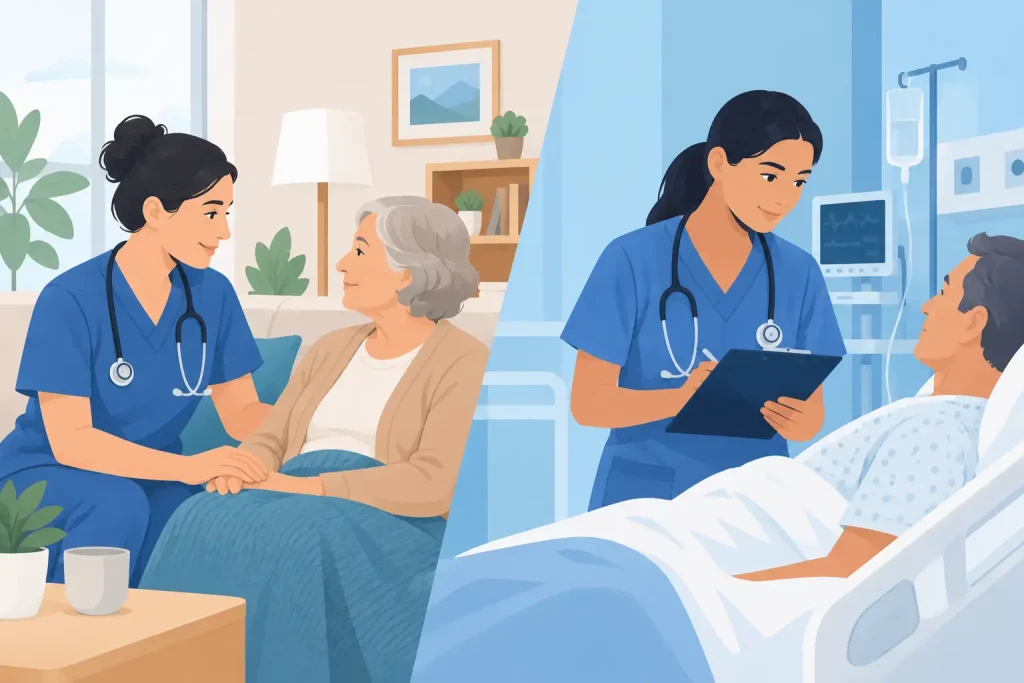
A child with a fever at midnight, an elderly parent recovering after a fall, or a loved one returning home after surgery can make one question feel urgent: should you arrange care at home or go to the hospital? The home nurse vs hospital nurse decision is not about which professional is better. Both are skilled clinicians. The right setting depends on the patient’s condition, the level of monitoring required, and whether treatment can be delivered safely outside a hospital.
For many families in Dubai, home nursing offers professional support without the stress of travel, waiting rooms, or disruption to a patient’s routine. Hospitals remain essential when symptoms are severe, unstable, or require advanced equipment and immediate specialist intervention.
Home Nurse vs Hospital Nurse: The Core Difference
A hospital nurse works within a clinical environment designed for acute and complex care. They are part of a larger care team that may include emergency physicians, surgeons, specialists, laboratory staff, pharmacists, and intensive care professionals. Hospital nurses manage patients who may need frequent observations, rapid medication adjustments, diagnostic testing, or urgent escalation.
A home nurse provides clinical care where the patient is most comfortable: at home. Their work is personalized and focused on the individual’s prescribed care plan. Depending on the patient’s needs, this may include medication administration, wound care, injections, IV support when clinically appropriate, vital-sign monitoring, catheter care, post-operative assistance, elderly care, newborn support, and health education for family caregivers.
The biggest difference is access to hospital infrastructure. In a hospital, imaging, specialists, operating rooms, and emergency response teams are immediately available. At home, the nurse brings professional assessment and planned medical support, but the setting is best suited to stable patients whose needs can be safely managed outside an inpatient unit.
When Home Nursing Is the Better Choice
Home nursing can be an excellent option when a patient needs ongoing clinical support but does not need to remain in a hospital. It allows care to fit around real family life while maintaining medical oversight.
Recovery after a hospital stay
The days after discharge can be difficult. A patient may still feel weak, need help with mobility, require dressing changes, or have a medication schedule that feels overwhelming. A nurse at home can help bridge the gap between hospital treatment and independent recovery. This support may reduce avoidable stress for both the patient and family members who are trying to coordinate care.
Home nursing is especially helpful after certain surgeries, injuries, or illnesses when a physician has confirmed that the patient is medically stable. The nurse can monitor recovery signs, identify concerns early, and reinforce discharge instructions in the patient’s own environment.
Elderly care with clinical support
Older adults often do better when they can remain in familiar surroundings. Their medication, nutrition, hydration, mobility, skin condition, and general wellbeing may all need close attention. A home nurse can provide clinical support while also giving families greater visibility into how their loved one is managing day to day.
For an elderly patient with multiple health conditions, the care plan should be clearly coordinated with the treating physician. Home care is not a replacement for medical follow-up, but it can make ongoing care safer, more consistent, and less exhausting for the family.
Newborn and mother support
The first weeks at home with a newborn can bring questions that do not always require a hospital visit but still deserve professional guidance. Home nursing may support new parents with newborn care, feeding guidance, basic monitoring, and recovery assistance for the mother, based on individual clinical needs.
This setting is often calmer than traveling with a new baby to a clinic. It also allows the nurse to offer practical guidance within the home routine parents are actually trying to manage.
Busy households that need planned treatment
Some patients need a nurse for a specific scheduled service, such as prescribed injections, IV therapy, sample collection, or regular monitoring. When the patient is stable and the service has been approved as appropriate for home care, an appointment at home can save considerable time.
For professionals, parents, and caregivers, this convenience matters. It means less time away from work, school, or family responsibilities without compromising on professional standards.
When a Hospital Nurse Is Essential
Comfort and convenience should never delay emergency care. Hospitals are the right choice when a patient may need rapid diagnostics, specialist treatment, surgery, or continuous monitoring that cannot be provided safely at home.
Seek emergency evaluation for symptoms such as chest pain, difficulty breathing, sudden weakness or confusion, fainting, uncontrolled bleeding, seizures, severe allergic reactions, major trauma, or a suspected stroke. A high fever in a very young infant, severe dehydration, or a rapidly worsening condition also requires prompt medical assessment.
A hospital is also more appropriate when a patient’s condition is unstable, pain is severe and uncontrolled, or frequent changes in treatment may be necessary. In these situations, the ability to obtain blood tests, scans, medications, and specialist input without delay can be life-saving.
Home nursing should not be viewed as a way to manage an emergency at home. It is a planned, clinically appropriate service for patients who are stable enough to receive care there.
Comparing Comfort, Attention, and Routine
In a hospital, nurses care for multiple patients in a structured, fast-moving environment. The level of nursing attention is based on the patient’s acuity and unit staffing. For a critically ill patient, that structure is exactly what they need.
At home, care is centered on one patient and their routine. The nurse can observe practical factors that are not visible in a hospital room, such as mobility challenges, medication storage, hydration habits, caregiver confidence, and fall risks around the home. This can make education more useful because it is tied directly to the patient’s daily life.
Home care also supports emotional comfort. Familiar surroundings, family presence, and a normal sleep routine can make recovery feel less intimidating. Still, comfort alone is not a clinical reason to avoid hospital care when a patient needs it.
What About Safety and Quality?
Safety starts with choosing the right level of care. A qualified home nurse should work within a physician-led or clinically supervised care plan, follow infection-control practices, document relevant observations, and know when to escalate concerns.
Before arranging home nursing, ask what services are appropriate for the patient’s diagnosis, what equipment or supplies will be used, and what to do if symptoms change. Families should also confirm the clinician’s licensing and relevant experience. In Dubai, DHA-certified professionals provide an important level of reassurance for patients receiving care at home.
Your Choice Healthcare provides nurse-at-home services designed around individual care needs, with clinically supervised support and responsive scheduling. The goal is not simply to bring a nurse to the door. It is to make appropriate medical care more accessible while keeping patient safety at the center of every visit.
Cost and Convenience: Look Beyond the Visit Price
Hospital care can involve transportation, parking, time away from work, long waits, and the practical challenge of bringing children or elderly relatives to appointments. For a stable patient who needs routine nursing support, home care may reduce many of these indirect burdens.
However, home nursing is not automatically the lower-cost choice in every situation. The total cost depends on the type of service, visit duration, frequency of care, medical supplies, and insurance coverage. A patient who requires advanced testing or constant observation may be better served in a hospital, where those resources are already available.
The most useful question is not, “Which option costs less?” It is, “Which setting delivers the right care safely, without creating unnecessary strain for the patient or family?”
How to Make the Right Decision
Start with the patient’s current condition. If there are emergency symptoms, choose hospital or emergency care immediately. If the patient is stable, speak with the treating physician or a qualified healthcare provider about whether home nursing is clinically suitable.
Then consider the practical needs around the care plan. Does the patient need help with medications, wound care, mobility, monitoring, or recovery education? Is travel difficult or exhausting? Is there a family member who needs guidance to support care between visits? These are strong reasons to explore professional nursing at home.
The best care setting is the one that matches the patient’s medical needs at that moment. When recovery can safely happen at home, skilled nursing support can turn a difficult period into one that feels calmer, more personal, and easier for the whole family to manage.