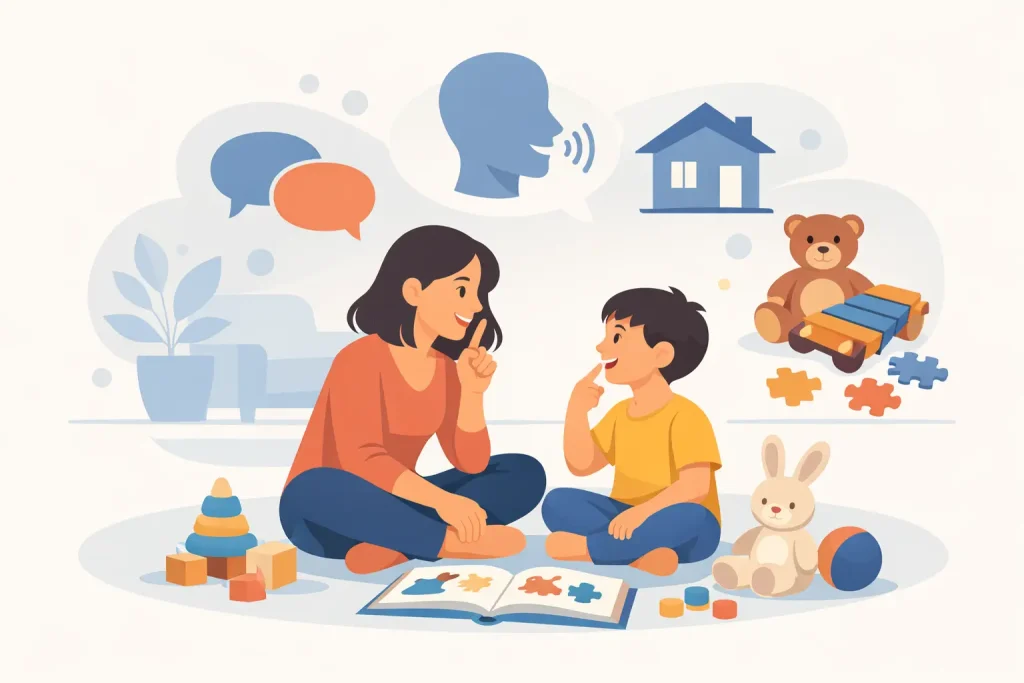
A child asking for “more juice,” telling you about a game, or trying a new sound may seem like a small moment. These everyday exchanges are where communication grows. If you are wondering how to support child speech, the most useful place to begin is not with flashcards or pressure. It is with calm, responsive conversation woven into the routines your child already knows.
Speech and language develop at different speeds, and children often make progress in bursts. Still, consistent support at home can help a child practice listening, understanding, speaking, and being understood with confidence.
Start With Connection, Not Correction
Children are more likely to communicate when they feel heard. Get down to your child’s eye level, notice what has captured their attention, and respond to their attempts to connect. A look, a gesture, a sound, or an unclear word can all be invitations to communicate.
Rather than asking your child to repeat a word until it sounds perfect, model the word naturally. If your child says, “tar” while pointing outside, you might say, “Yes, car. The blue car is going fast.” This lets them hear the correct sound without making the conversation feel like a test.
Keep your language just a little ahead of your child’s current level. If they use single words, add one or two words. When they say, “Dog,” you can respond, “Big dog” or “Dog running.” If they are using short phrases, expand them into a simple sentence: “Want cookie” becomes “You want a cookie.” This approach supports speech and language while respecting where your child is now.
Make Everyday Routines Language-Rich
You do not need long, formal practice sessions to build communication. Meals, bath time, getting dressed, car rides, and bedtime offer repeated opportunities to use the same meaningful words. Repetition is helpful when it happens naturally and has a clear purpose.
At breakfast, name foods, actions, and choices: “Banana or yogurt?” “You are stirring.” “The cup is full.” During dressing, talk about body parts, colors, and positions: “Sock on,” “Shirt over your head,” or “Where is your shoe?” Pause after speaking so your child has time to look, gesture, make a sound, or answer.
A pause can feel longer than it is. Try silently counting to five before stepping in. Some children need extra processing time, especially when they are learning new words or organizing what they want to say.
It also helps to offer choices instead of questions that can be answered only with yes or no. “Do you want the red cup or the green cup?” gives your child a reason to use a word, point, or attempt a response. Keep choices simple at first, then increase the language as they become more confident.
Use Play to Encourage Speech Without Pressure
Play gives children a reason to communicate. Follow your child’s lead instead of directing every activity. If they are building a tower, talk about what they are doing: “Up, up, up,” “That is tall,” and “Oh no, it fell!” If they are playing with vehicles, add sounds and action words such as “go,” “stop,” “beep,” and “crash.”
Pretend play can be especially valuable for older toddlers and preschoolers. A toy kitchen, doctor kit, dolls, or stuffed animals can encourage words for actions, feelings, and simple social exchanges. You can make the teddy bear hungry, sleepy, or hurt, then model phrases like “Teddy needs help” or “Time for bed.”
Avoid turning play into a quiz. Repeatedly asking, “What is this?” may frustrate a child who knows the word but does not want to answer on demand. Comments are often more effective than questions. Say, “That truck is loud,” then wait. Your child may respond with a sound, a word, or an idea of their own.
Read Together in a Way That Invites Talking
Reading is not about finishing every page. It is about sharing attention, hearing language, and giving your child opportunities to join in. Choose books with clear pictures, familiar routines, repeated phrases, and topics your child enjoys.
Point to pictures and describe what you see. Ask simple, open invitations such as, “What do you notice?” or “Where did the cat go?” For a child who is not yet using many words, you can ask them to point, turn the page, copy an animal sound, or fill in one familiar word from a repeated line.
Read the same books more than once. Familiarity helps children anticipate words and participate more easily. If your child wants the same book every night, that repetition is supporting learning, not holding it back.
Support Clearer Speech Gently
Many young children simplify sounds as they learn to talk. They may leave off parts of words, substitute one sound for another, or be difficult for unfamiliar listeners to understand. This can be typical at certain ages, but it is still useful to create a supportive speaking environment.
Speak clearly at a natural pace. Do not exaggerate sounds so much that speech feels unnatural, and do not ask your child to slow down or “use your words” when they are upset. First, acknowledge the message: “You are frustrated. You want the toy.” Once they feel understood, they are better able to listen and try again.
When you do not understand, be honest and helpful. Say, “I heard you say something about the ball. Show me what you mean,” or “Can you tell me another way?” Looking at what your child is pointing to, offering two possible choices, and using gestures can reduce frustration while keeping communication moving.
Limit Barriers to Conversation
Screens can sometimes be part of family life, but they should not replace back-and-forth interaction. Children learn language most effectively through real people who respond to their sounds, expressions, and ideas. If your child watches age-appropriate content, watching together and talking about it is more useful than passive viewing.
Background television can also make it harder to notice and respond to a child’s communication attempts. Create small periods of quiet during meals, play, and bedtime whenever possible. A calm environment helps both children and adults listen better.
For families who use more than one language, continue speaking the language that feels most natural and meaningful at home. A strong foundation in a family’s home language supports communication overall. Switching to a language a parent is less comfortable using may reduce the quality and amount of interaction. If there are concerns about speech or language, a speech-language professional can advise on your child’s individual needs in a multilingual home.
Know When Professional Support May Help
Every child’s development is individual, and one missed milestone does not automatically mean there is a serious concern. However, early guidance can be valuable when a child is not progressing as expected, has frequent frustration around communication, or is difficult to understand compared with peers.
Consider speaking with your child’s pediatrician or a qualified speech-language professional if your child does not respond consistently to sounds or their name, has lost words or communication skills they once used, has trouble understanding simple directions, or rarely attempts to communicate through sounds, gestures, or words. It is also worth seeking advice if feeding, chewing, swallowing, voice quality, or stuttering concerns are present.
A professional assessment does not label a child or predict their future. It identifies strengths, checks areas that may need support, and helps families understand what to do next. Hearing should also be considered, because ear infections, fluid in the ears, or hearing differences can affect speech and language development.
For busy families, speech therapy at home can make assessment and practice feel more comfortable. A therapist can observe how your child communicates in familiar routines, coach caregivers in real time, and build goals around the words and situations that matter most at home. Your Choice Healthcare provides personalized, clinician-led home healthcare support in Dubai for families who need convenient guidance in a familiar setting.
How to Support Child Speech With Consistency
The goal is not to make every interaction a lesson. It is to create many small moments in which your child learns that their voice, gestures, sounds, and words have value. Talk about what you are doing, listen closely, respond warmly, and give them time.
Progress may look like a new sound, a longer phrase, less frustration, or a child initiating more often. Those changes deserve notice. With patient daily interaction and timely professional support when needed, your child can keep building communication skills in the place they feel safest: home.